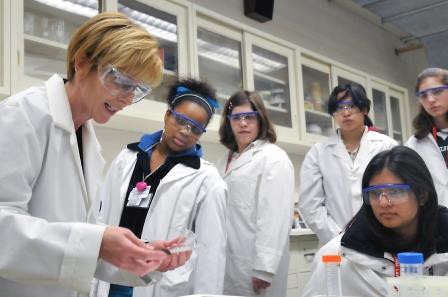
Georgia Everett has taught for 13 years in Indiana and has been a member of AFT Indiana for nine years. Beginning in 2012, she participated with a team of other AFT members across the nation to give feedback and suggestions in the development of the Next Generation Science Standards. Since the NGSS were finalized and released, the team has continued to work on professional development opportunities for other teachers as well as on how to improve lessons to incorporate NGSS.
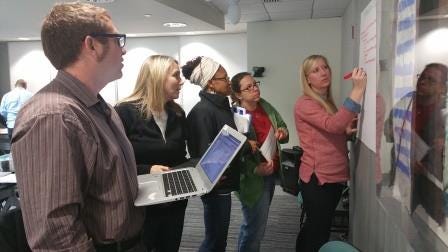 The Next Generation Science Standards were built upon Framework for K-12 Science Education. Some states already have adopted or are close to adopting the NGSS. Whether or not you live in a state that is shifting to NGSS, you can integrate the practices and philosophies associated with the framework used to develop the standards. Indiana has not chosen to adopt NGSS, but I have chosen to incorporate the NGSS goals in my classroom through the use of the Science and Engineering Practices and Crosscutting Concepts in my classroom. Although the standards may be a bit different, the way of doing science remains the same in a classroom built off of the framework. (To learn more about the standards and the three dimensions involved, visit http://www.nextgenscience.org.)
No matter the direction your state is choosing to go with NGSS, you can still apply the three dimensions of science teaching because they reflect good science teaching in general. This shift is not something that can happen overnight; it takes time. I have been working with the NGSS for four years and am still learning what I can do to better incorporate all three dimensions into my classroom and move from a teacher-centered to a student-driven classroom. As the shift to three-dimensional teaching occurs, it may be necessary for a teacher to begin by focusing on applying only one or two dimensions and then working toward total integration.
Prior to my work with the NGSS, most of my units included a day or two of notes, a step-by-step lab that lasted a day or two, and then some practice worksheets covering the content. Students may or may not have been engaged in the work being completed because the focus of the class was very teacher-driven and not student-centered. After spending more time working with the three dimensions of the NGSS, as well as the framework used to build the standards, my teaching style began to shift to a more student-centered approach.
Now, a unit in my class focuses not just on what I have to share, but also on what my students already know about the topic and what we can build from that knowledge. The unit on cell energy in my classroom, specifically on photosynthesis, begins with the central question: “Why do we need plants, and if all the plants in our state were to disappear, what would the impact be on you?” I do not simply lecture about the topic of photosynthesis but also let students explore and engage in learning through the use of articles and video clips. An answer that often comes up is that photosynthesis wouldn’t happen without plants. This response lets me know that my students have a little background on the topic, and we can start investigating what exactly photosynthesis is, and whether plants are the only organisms that can do photosynthesis. The class discussions lead to a discussion about the pigments found in different organisms, so then we investigate these pigments through chromatography to compare what types of pigments are found in two different organisms. Students are assessed periodically using quick bell work questions or more formal online questioning to see where there are still gaps in their learning and what misconceptions still need to be addressed.
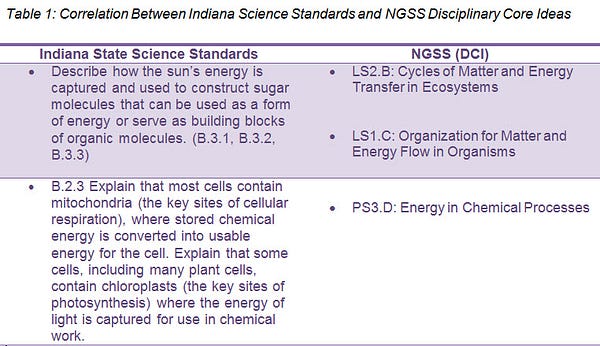
The Indiana State Standards that are addressed with this unit can be correlated to the Disciplinary Core Ideas (DCI) that are part of NGSS. See Table 1 to the left.(Resources for this unit can be found in Photosynthesis Unit Intro.)
Throughout the unit, there is a shift to a more three-dimensional learning style. (To find out more about the three dimensions, visit http://www.nextgenscience.org/three-dimensions where each dimension is discussed in more detail.) In this unit, students are using the practice of investigating a problem while also applying the crosscutting concept of cause and effect. Even though we have not shifted to the NGSS in Indiana, I am still able to apply the disciplinary core ideas in my classroom because we are still addressing the life science topic of ecosystems and energy.