



This resource was origninally published on Science Friday on July 24, 2017 and has been reposted with their permission. You can find the original post here.
On August 21, 2017, people across North America will be able to view either a total or partial solar eclipse. The last time most people in the U.S. were able to observe a total solar eclipse was 1991 and the next time won’t be until 2024! Here’s a guide to get you ready for the big event.

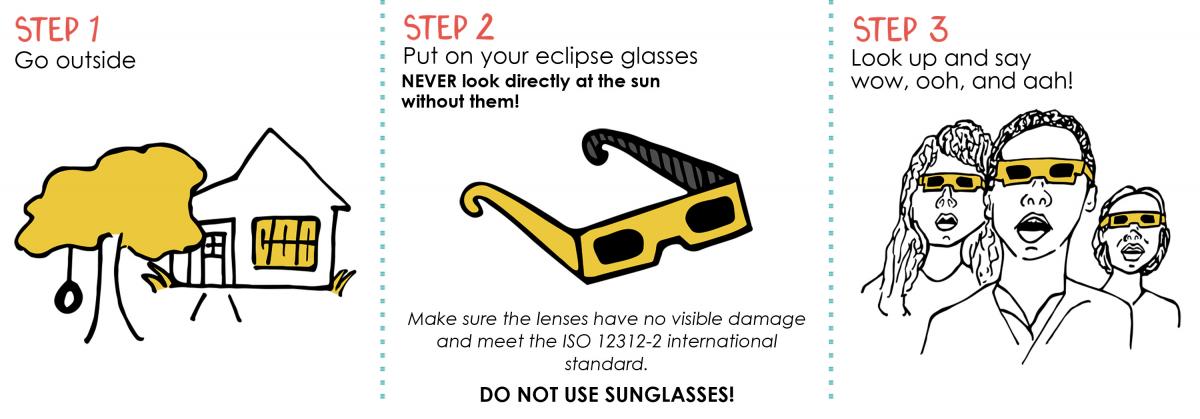
Psst! With your new eclipse glasses, you can look at the sun on any clear day. So go out and give it a try!
Solar Eclipse Safety Tips
Safe eclipse viewing glasses or handheld solar viewers have certification (ISO 12312-2 international standard) and manufacturer information printed on them. Do not use filters that are scratched, punctured, or wrinkled. Do not use sunglasses because they are not safe for looking directly at the sun! If you don’t have access to eclipse glasses or handheld solar viewers, use a pinhole viewer or solar viewing projector.
Still need eclipse glasses? Try your local public radio station, public library, or science center. You can also purchase eclipse glasses here or here. Check out this list of reputable providers compiled by the American Astronomical Society for more recommendations of where to purchase glasses online.
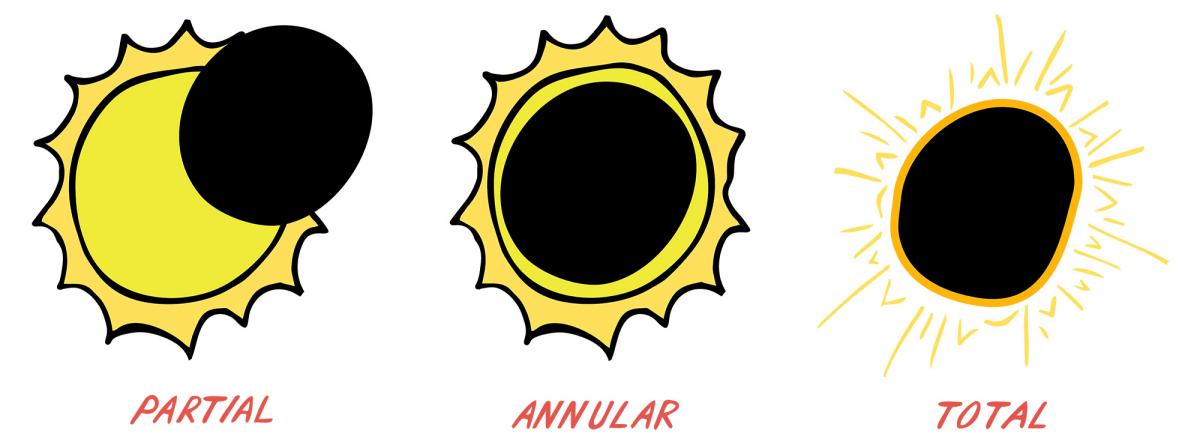
If you are in the path of totality the sun will be completely hidden from view and the sky will appear dark. In the path of totality, you can remove your eclipse glasses during the brief period of time when the moon is completely blocking the sun. The path of totality passes through several major cities: Salem, OR; Idaho Falls, ID; Lincoln, NE; Kansas City, MO; St. Louis, MO; Nashville, TN; Columbia, SC; and Charleston, SC. Click here for a map of the August 2017 total solar eclipse.
The eclipse on August 21, 2017 will travel from west to east, first “coming ashore” in Oregon at around 9:05 am Pacific Time (12:05 pm Eastern). It will leave South Carolina at around 4:09 pm ET (1:09 pm PT). The eclipse completes its path across the United States in just over 94 minutes. If you want to find out exactly what the solar eclipse will look like for you visit eclipsemega.movie/simulator.

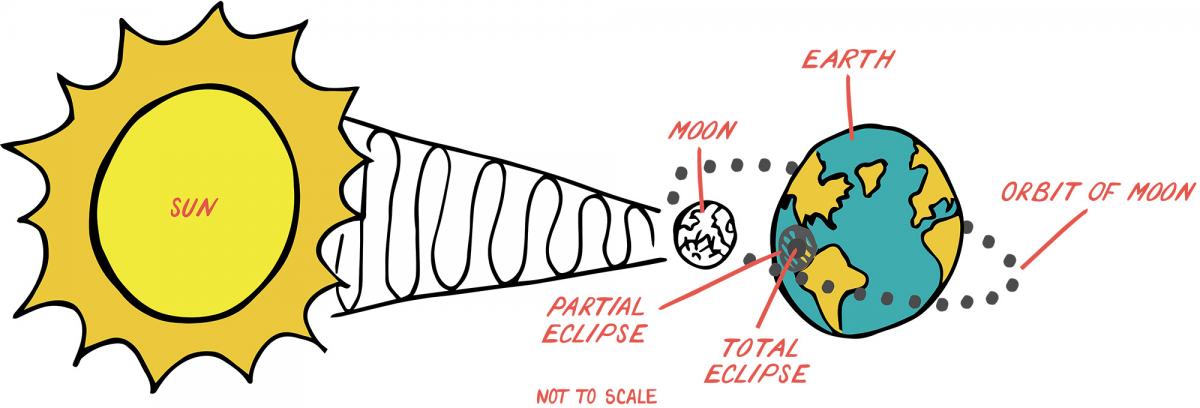

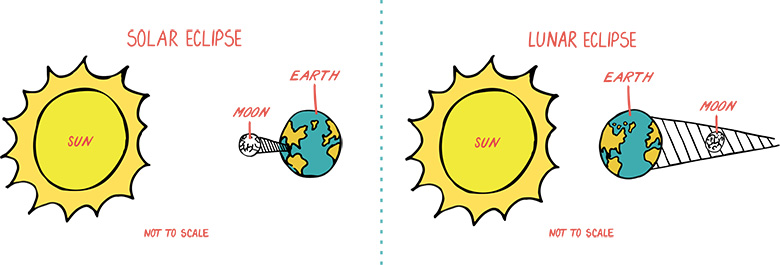
Eclipses occur when either the earth or the moon blocks light from the sun. Solar and lunar eclipses occur during periodic alignments of the Sun, Earth, and the Moon.

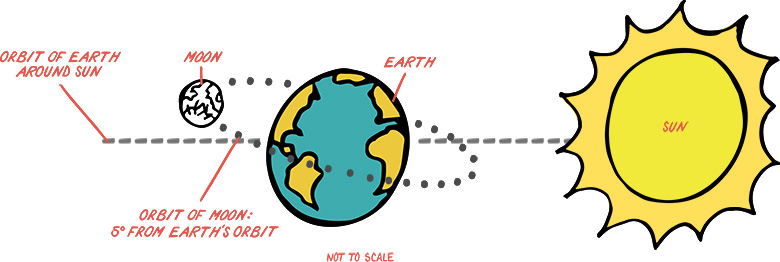
The moon’s orbit is tilted 5 degrees from the earth’s orbit (around the sun), so the moon is usually too high or too low to cause a solar eclipse.
For more information about the 2017 solar eclipse visit
http://eclipse2017.nasa.gov/
Print the eclipse guide
This resource was developed in collaboration with the NASA Heliophysics Education Consortium.
MEET THE WRITER
About Xochitl Garcia
Xochitl Garcia is Science Friday’s education program assistant. She is a former teacher who loves hanging out with her fat-tailed gecko, which, despite the efforts of students, family, friends, and a fantasy football league to name it, is still only referred to as “the gecko.”
MEET THE ILLUSTRATOR
About Carrie Lapolla
I'm a Brooklyn-based Illustrator and Graphic Designer originally from Rhode Island. A Pratt Institute graduate, I have a B.F.A in Communications Design and experience in branding, social media, and marketing. Currently, I'm the Brand Manager at Village Print —a small locally owned print shop in NYC— where I get the pleasure of drawing all day.

Covering the outer reaches of space to the tiniest microbes in our bodies, Science Friday is the source for entertaining and educational stories about science, technology, and other cool stuff. For 25 years, we’ve introduced top scientists to public radio listeners and reminded them how much fun it... See More
Advertisement

mariagagnon09_2610591
March 3, 2018, 5:44 am


Exposing your unprotected eyes to the sun during a solar eclipse can cause solar retinopathy, also known as "eclipse blindness". This exposure can temporarily or permanently damage or destroy cells in the retina. The damage can take up to a few days to be fully expressed with symptoms including loss of central vision, altered color and blurry or distorted vision. Thus it is highly recommended to wear wholesale sunglasses during the solar eclipse. Instead of purchasing sunglasses from a local store one can also buy wholesale sunglasses from the online store like https://citysunglass.com/product-category/mens-sunglasses, where sunglasses in bulk are available at cheap.