
lesson
3 Downloads
Write a review
beta
EdBrAIn It
EdBrAIn uses AI to customize lesson resources for your students’ needs.

Spring Math Mystery Project – Solve the Case of the Stolen Daffodils! for 3rd Grade

Share

Share On Facebook
Share On Twitter
Share On Pinterest
Share On LinkedIn
Email
Subject Math
Grade Level Grade 3
Resource Type Assessment, Worksheet
Standards Alignment
Common Core State Standards

About This Lesson

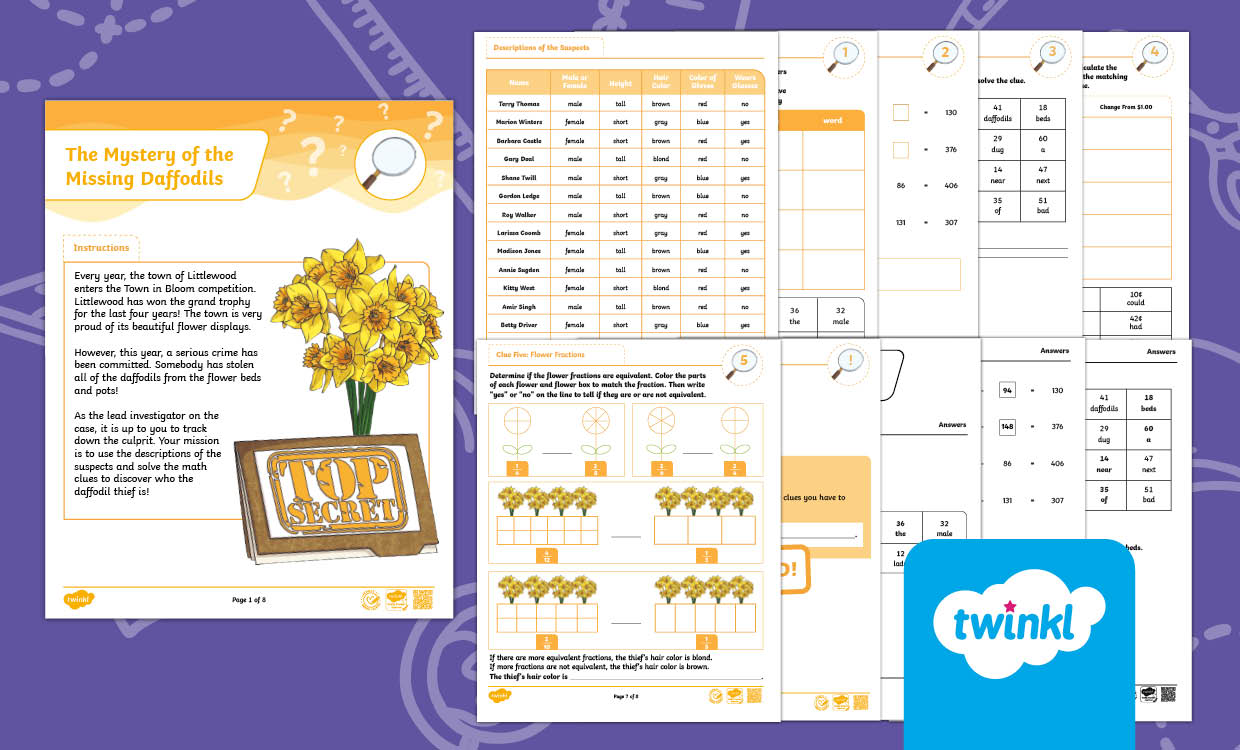
Bring springtime fun into your math classroom with this engaging 3rd-Grade Math Mystery Project! In this Common Core-aligned activity, students take on the role of detectives as they solve math problems to uncover the culprit behind the stolen daffodils in the town of Littlewood.

This interactive and skill-building mystery covers essential math concepts while keeping students engaged in a fun, story-driven challenge! With an included answer key, students can also practice self-assessment and independent problem-solving.

🌼 What’s Included?

🕵️ Spring-Themed Math Mystery – A fun, interactive detective story where students solve math problems to track down the daffodil thief!

Math Skills Covered:

  • Perimeter of shapes
  • Missing number addition & subtraction
  • Multiplication
  • Money (counting change)
  • FractionsAnswer Key for Easy Self-Assessment & Grading

🎯 How to Use:

✔️ Perfect for spring math centers, early finishers, or enrichment activities✔️ Engage students in problem-solving and logical reasoning✔️ Encourage teamwork and collaboration in small groups

This no-prep, print-and-go resource is ideal for spring learning, making math exciting and meaningful! Download now and let your students become math detectives this season! 🌷➗🔎

Discover more Twinkl resources at: https://www.twinkl.com/l/zkxo5

Resources

Files

Standards

Students recognize area as an attribute of two-dimensional regions. They measure the area of a shape by finding the total number of same-size units of area required to cover the shape without gaps or overlaps, a square with sides of unit length being the standard unit for measuring area. Students understand that rectangular arrays can be decomposed into identical rows or into identical columns. By decomposing rectangles into rectangular arrays of squares, students connect area to multiplication, and justify using multiplication to determine the area of a rectangle.
Students describe, analyze, and compare properties of two-dimensional shapes. They compare and classify shapes by their sides and angles, and connect these with definitions of shapes. Students also relate their fraction work to geometry by expressing the area of part of a shape as a unit fraction of the whole.

Reviews

Write A Review

Be the first to submit a review!

Advertisement