





About This Lesson
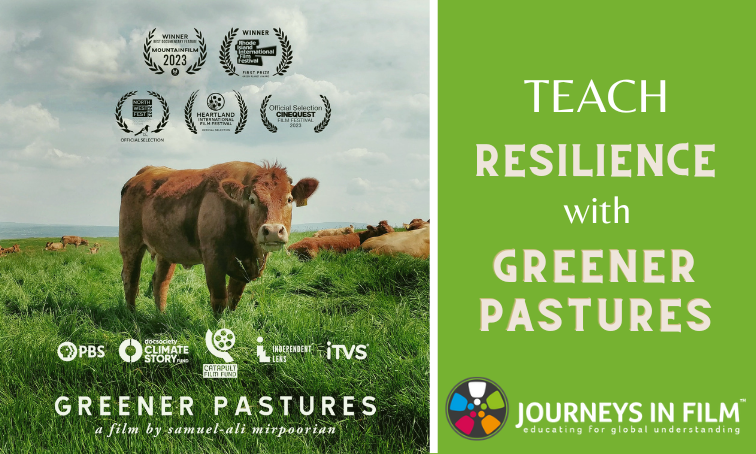
Award-winning documentary film Greener Pastures is an engaging teaching tool to explore stories of resilience in the context of the crisis facing contemporary family farmers in the US Midwest. It offers opportunities to highlight the importance of mental health support as well as environmental learning opportunities around soil conservation and healthy food systems.
The guide includes sections on:
- Introduction to the Film
- Director’s Statement
- Navigating the Space Between What We Cannot Control and What We Can (on hardship, copying strategies and resilience)
- Back to Our Roots (on family traditions)
- Deep Connections: Soil and Food (on regenerative farming and sustainable agriculture)
- Connecting the Dots: Health
- Moving Beyond a Rock and a Hard Place: Community Action and Engagement
How to teach with this film + discussion guide
Journeys in Film lessons are designed to be simple enough for the beginning teacher to manage easily, with all materials classroom-ready.
- Our discussion guide sections can be used independently of one another, so a teacher can select just the previewing discussions that establish context and provide the student with the concepts needed to understand the film, and then use follow-up discussions to extend understanding.
- A pair of teachers could collaborate; for example, a Social Studies teacher and and a Counselor could teach different discussion sections of the same film.
- A teaching team could set aside sufficient time to have a “film festival” and teach a truly cross-disciplinary unit that would engage students with a wide range of learning modes and interests.
- Our discussion guide could also become the basis for an afterschool club activity or for a homeschooling unit.
About the film
Greener Pastures provides an intimate window into the lives of four multigenerational farming families as they navigate the stressors that have contributed to farming having one of the highest rates of suicide of any U.S. occupation, connecting the dots between mental health, industrialization, food production and climate change. It’s a must-see film that adds context to the food on our tables that we as consumers may take for granted.


