
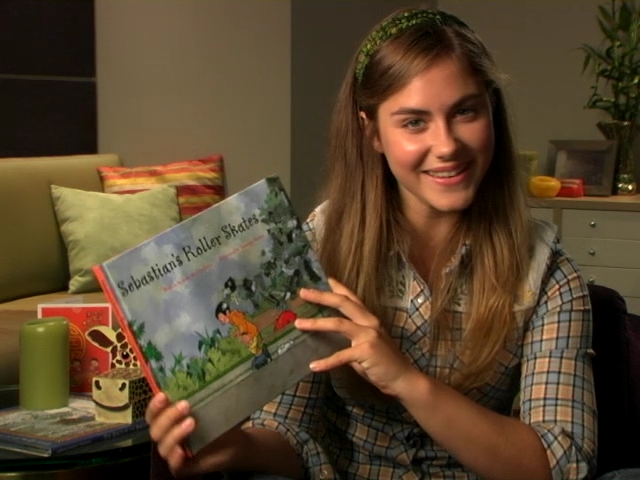
Sebastian's Roller Skates read by Caitlin Wachs
lesson
53 Downloads
Write a review
beta
EdBrAIn It
EdBrAIn uses AI to customize lesson resources for your students’ needs.

Sebastian's Roller Skates read by Caitlin Wachs

Share

Share On Facebook
Share On Twitter
Share On Pinterest
Share On LinkedIn
Email
Grade Level Grades 1-3
Resource Type Activity
Attributes
Standards Alignment
Common Core State Standards

About This Lesson

Sebastian didn't talk very much, even though he had a lot to say. Sebastian was shy. He was very shy. But when he finds a pair of old roller skates in the park, he learns how to do much more than skate...

Storyline Online's Sebastian's Roller Skates is read by Caitlin Wachs, written by Joan de Deu Prats and illustrated by Francesc Rovira.

Resources

Files

beta
EdBrAIn uses AI to customize lesson resources for your students’ needs.

Sebastian'sRollerSkates_TeacherActivityGuide.pdf

Activity
October 1, 2020
564.11 KB
Videos
Sebastian's Roller Skates read by Caitlin Wachs
Remote video URL

Standards

Participate in collaborative conversations with diverse partners about grade 2 topics and texts with peers and adults in small and larger groups.
Engage effectively in a range of collaborative discussions (one-on-one, in groups, and teacher-led) with diverse partners on grade 3 topics and texts, building on others’ ideas and expressing their own clearly.
Recount or describe key ideas or details from a text read aloud or information presented orally or through other media.
Determine the main ideas and supporting details of a text read aloud or information presented in diverse media and formats, including visually, quantitatively, and orally.
Describe how characters in a story respond to major events and challenges.
Describe characters in a story (e.g., their traits, motivations, or feelings) and explain how their actions contribute to the sequence of events.
Ask and answer such questions as who, what, where, when, why, and how to demonstrate understanding of key details in a text.
Ask and answer questions to demonstrate understanding of a text, referring explicitly to the text as the basis for the answers.
Write informative/explanatory texts in which they introduce a topic, use facts and definitions to develop points, and provide a concluding statement or section.
Write informative/explanatory texts to examine a topic and convey ideas and information clearly.
birdheim
birdheim September 20, 2014

Cute story and great illustrations. The activity guide also has nice suggestions of student activities to go along with the story.

Advertisement