
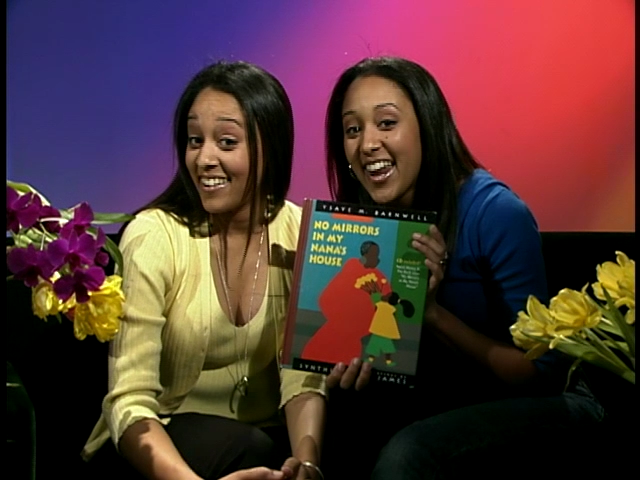
No Mirrors in My Nana's House read by Tia & Tamera Mowry
lesson
51 Downloads
Write a review
beta
EdBrAIn It
EdBrAIn uses AI to customize lesson resources for your students’ needs.

No Mirrors in My Nana's House read by Tia & Tamera Mowry

Share

Share On Facebook
Share On Twitter
Share On Pinterest
Share On LinkedIn
Email
Grade Level Grades 1-3
Resource Type Activity
Attributes
Standards Alignment
Common Core State Standards

About This Lesson

There are no mirrors in my Nana's house....No mirrors to reflect the cracks in the wall, the clothes that don't fit, the trash in the hallway. No mirrors. But there is love. The beauty in this child's world is in her Nana's eyes. It's like the rising of the sun...

Storyline Online's No Mirrors in My Nana's House is read by Tia and Tamera Mowry, written by Ysaye M. Barnwell and illustrated by Synthia Sant James.

Resources

Files

beta
EdBrAIn uses AI to customize lesson resources for your students’ needs.

NoMirrorsinmyNanasHouse_TeacherActivityGuide.pdf

Activity
October 1, 2020
781.97 KB
Videos
No Mirrors in My Nana's House read by Tia & Tamera Mowry
Remote video URL

Standards

Participate in collaborative conversations with diverse partners about grade 2 topics and texts with peers and adults in small and larger groups.
Engage effectively in a range of collaborative discussions (one-on-one, in groups, and teacher-led) with diverse partners on grade 3 topics and texts, building on others’ ideas and expressing their own clearly.
Recount or describe key ideas or details from a text read aloud or information presented orally or through other media.
Determine the main ideas and supporting details of a text read aloud or information presented in diverse media and formats, including visually, quantitatively, and orally.
Describe how characters in a story respond to major events and challenges.
Describe characters in a story (e.g., their traits, motivations, or feelings) and explain how their actions contribute to the sequence of events.
Ask and answer such questions as who, what, where, when, why, and how to demonstrate understanding of key details in a text.
Ask and answer questions to demonstrate understanding of a text, referring explicitly to the text as the basis for the answers.
Write informative/explanatory texts in which they introduce a topic, use facts and definitions to develop points, and provide a concluding statement or section.
Write informative/explanatory texts to examine a topic and convey ideas and information clearly.
birdheim
birdheim September 20, 2014

Students would enjoy listening to a story read to them by tv stars. Thanks for sharing.

Advertisement